
Building Strong Community Group Programs
Building Community Group Programs That Create Value
Seven attributes that turn ad hoc meetups into lasting user group programs, plus the guided autonomy model, drawn from a library of 200+ group case studies.
Lasting user group programs share seven attributes: facilitated peer networking, professional and career development, real resources and tools, exclusive access, direct influence over the product, visible recognition, and integration with the brand itself. Programs that only do the last one become marketing. Programs that do none of them become a calendar invite nobody accepts.
In 2000, Fast Company handed me a subscriber list, a discussion guide, and an organizer's button, and asked me to start a Company of Friends chapter in Louisville. Fifteen people showed up to the first meeting, and I've been hooked on what local groups can do ever since. I went on to build programs at Dell and Autodesk, and Structure3C has designed or refined many more. The eight programs profiled in this briefing are drawn from a library of more than 200 group case studies.
The seven attributes:
Facilitated peer networking
Professional and career development
Resources and technical tools
Exclusive access and insider privileges
Direct influence and co-creation
Recognition and status
Brand integration and alignment
1. Facilitated peer networking
Structured chances for members to connect, compare notes, and build lasting relationships with peers who share their problems. The operative word is structured. A room and a start time is not a networking program.
Adobe User Groups run workshops, AMAs, interactive presentations, and happy hours, formats chosen specifically to spark conversation rather than broadcast at people. AWS User Groups organize Community Days, peer-led regional conferences with technical talks, workshops, and hands-on labs, all built around connection rather than announcement.
2. Professional and career development
Participation turns into sustained commitment when it produces something a member can put on a resume. Skills, visibility, credentials.
AWS User Group members get certification vouchers, product subscriptions, and weekly expert webinars, which makes attendance directly useful to Monday morning. Salesforce User Groups connect to career advancement through Trailhead certifications and in-person events. In both cases the company is subsidizing its members' careers, and getting a durable community in return.
3. Resources and technical tools
This is the trait most programs skip, and it's the one group leaders feel most. Running a good meetup is real work. Programs that invest in platforms, toolkits, content, and funding make that work possible for a volunteer.
Adobe supplies the Bevy event platform, branded slide decks, and current product content, so a leader can run a polished session without building one from scratch. Autodesk gives leaders a speaker database, a DAM portal, promotional resources, and quarterly coaching calls.
4. Exclusive access and insider privileges
Access to people, early products, and information members cannot get anywhere else. It is among the most compelling reasons to keep showing up, and among the cheapest benefits to provide.
IBM User Group members attend special events and workshops and get private presentations and whitepapers. AWS User Group members reach AWS service teams directly, see early webinars on new services before general release, and get Community Days that bring AWS expertise to their city.
5. Direct influence and co-creation
When members have genuine input into products, programs, or community direction, ownership deepens. Symbolic input does the opposite.
Autodesk frames its Group Network explicitly as co-built with customers and existing groups, and backs that with roadmap access and direct check-ins with staff. Salesforce Trailblazer Community Group members connect to the IdeaExchange, where participation converts into votes that actually move the product roadmap. Note the mechanism in both cases: a specific, visible path from member input to product decision.
6. Recognition and status
Visible recognition rewards contribution and marks members as experts inside a professional network they care about.
IBM features user group leaders on its main user group page and promotes groups across the IBM Community, which puts leaders in front of a large, respected audience. Adobe recognizes leaders with exclusive badges, leader-only swag, and an annual Leader of the Year award, while active members build public credibility through Adobe's recognition channels.
7. Brand integration and alignment
The most effective programs are woven into the brand, so local activity connects to the products and company members already depend on. Isolated groups drift.
Salesforce Trailblazer Community Groups are embedded in Salesforce's identity and culture, to the point that the Trailblazer identity is itself a motivator. IBM builds the connection into the leadership structure: every IBM User Group has both a User Group Leader, who is an IBM customer or partner, and a User Group Liaison, who is an IBM employee that helps plan meetings, shares updates, and attends calls. That's brand integration as an org chart rather than a logo.
The guided autonomy model
The strongest programs do two things at once. They give group leaders real central support and real local autonomy. Lean too far toward either and the program stalls.
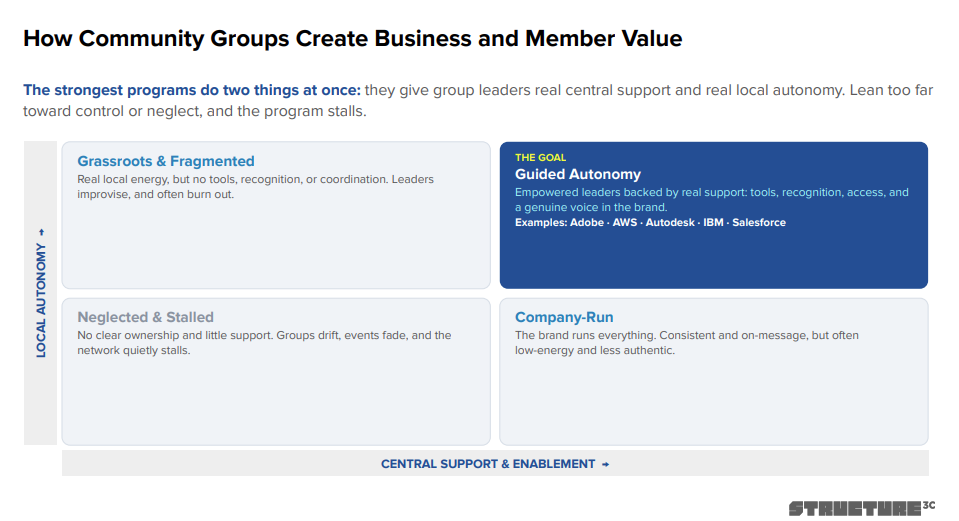
Four positions on those two axes:
Guided autonomy is the goal. Empowered leaders backed by real support: tools, recognition, access, and a genuine voice in the brand. Adobe, AWS, Autodesk, IBM, and Salesforce all operate here.
Grassroots and fragmented means real local energy with no tools, recognition, or coordination. Leaders improvise, and they burn out.
Company-run means the brand runs everything. Consistent and on-message, but usually low-energy and less authentic.
Neglected and stalled means no clear ownership and little support. Groups drift, events fade, and the network goes quiet without anyone deciding to end it.
Most programs are not designed into one of these positions but they inevitably drift into one.
What lasting programs look like at scale
The scale numbers are worth stating plainly, because they're what a decade of guided autonomy compounds into. Salesforce runs a twenty-year-old user group program with more than 750 active groups and over 1,300 volunteer leaders producing more than 4,000 events a year. AWS has more than 590 user groups worldwide. WordPress Meetups operate as a volunteer-run global network with no cost barriers, no minimum size, and a shared code of conduct, funded so that meetup dues are covered by a nonprofit.
None of those numbers came from a launch campaign. They came from treating group leaders as partners for long enough that the network started sustaining itself.
Get the full briefing
The full briefing profiles all eight programs with program benefits and business impact for each: Adobe, Atlassian, Autodesk, AWS, IBM, Salesforce, LEGO, and WordPress. It includes the guided autonomy model in full and the three ways programs fail when the balance is wrong.
Published August 2026. If you want to talk through your own program, get in touch.
Download the report here.
Please note: By downloading the report, you agree to cite with attribution. Resale, republication, and commercial reuse require permission. © 2026 Structure3C.
Next steps:
We brief teams on our extensive research, review systems that are already running, and design new ones.
If you have questions or want to talk through your own, get in touch.
FAQ
What is a user group program?
A user group program is a company-supported network of local or interest-based groups run by customers rather than employees. Members meet regularly to learn, share practice, and connect with peers. Adobe User Groups, AWS User Groups, IBM User Groups, and Salesforce Trailblazer Community Groups are examples.
What is the difference between a user group and a meetup?
A meetup is a single gathering. A user group program is the structure around recurring gatherings: leader selection and support, resources, recognition, and a connection back to the company. Most grassroots meetups fade because the gathering exists without the structure.
Why do most community group programs fail?
The most common failure is treating group leaders as volunteers rather than partners. Running a good group is real work. Without tools, recognition, and access, leaders burn out, and the network stalls or fragments regardless of how much local enthusiasm existed at the start.
Which companies run the best user group programs?
This briefing profiles eight: Adobe, Atlassian, Autodesk, AWS, IBM, Salesforce, LEGO, and WordPress. They span software, hardware, consumer products, and open source, which is deliberate. The characteristics transfer across all four.