

Community Reputation and Motivation Systems
The Participation Advantage You Can't Buy
The five strategies that make reputation mechanics work, a systems map connecting member motivation to program impact, and a mechanic-by-mechanic look at how Salesforce, Atlassian, and Mendix build recognition worth earning.
Most community platforms ship with a reputation system by default, and most organizations leave the defaults in place. That's a good part of the problem. Points, badges, and a leaderboard cost almost nothing now and differentiate nothing on their own. What decides whether any of it works is the strategy underneath, whether the program helps members make progress toward their own goals, and whether anyone designed it to. I've designed reputation and advocacy programs on the brand side at TechRepublic, Dell, and Autodesk, and Structure3C has studied more than 100 of them since 2015 to find what holds up over time.
The programs that work start upstream of the mechanics. Before a badge gets designed, the host organization decides which member actions matter, learns what members are actually trying to accomplish, and builds motivation and engagement strategies that serve both at once. Points and levels come last, as the visible layer that makes progress legible to everyone else. This report maps that chain, from member motivation through strategy and platform to program impact, and breaks the strategy work into five parts: community care, accomplishment journeys, information and qualification, advocacy and leadership, and appreciation and feedback.
The mechanics were never the hard part.
Where these systems fail is the gap: a leaderboard recognizes ten people, the eleventh member does the math, and participation concentrates at the top while everyone else watches.
The programs that avoid this trap recognize members at different stages, on different time horizons, for different kinds of contribution. Atlassian runs leaderboards for the last thirty days, the quarter, and all time, and puts them at the topic level where a new member can actually place. Mendix qualifies MVPs along four specialized paths instead of one. Salesforce guides members toward stewardship through Forum Ambassador status and visible presence in the community.
Recognition earned this way is career capital, which is why it holds attention long after a points balance no longer matters.
The five strategies
Community care and maintenance
Accomplishment journeys and campaigns
Information and qualification
Advocacy and leadership programs
Appreciation, feedback, and adaptation
1. Community care and maintenance
The day-to-day work of rating content, flagging spam, contributing answers, and sharing expertise. It's foundational, it's unglamorous, and it's what makes a community a clean, well-lit space rather than an archive of unanswered questions.
Members who like helping tend to start doing this on their own. Whether they keep doing it depends entirely on how the host organization notices and supports the work. Salesforce guides members toward stewardship through Forum Ambassador status and visible presence in the community, which turns care work into a recognized role rather than invisible labor.
2. Accomplishment journeys and campaigns
Structured paths designed by the host organization to guide members toward achievements that advance their careers. Journeys are linear progress toward a specific goal over a long period. Campaigns push a specific action over a short one. Both produce recognition and visibility, and both make it easier for other members to find the people worth connecting with.
Salesforce Trailhead Trails are guided journeys with points and modules attached. Atlassian publishes a visual explanation of its badging system, so the path is legible before a member commits to it. Mendix previews the next badges a member could earn, which converts an abstract system into a specific next step.
3. Information and qualification
Making it easy, in the flow of the experience, for members to judge the quality of content, find relevant people, and see their own progress. Documentation is the floor. What matters is meeting members where they are at the moment they're deciding whether to engage.
Atlassian shows member credentials on rollover at the discussion topic level and runs leaderboards scoped to individual topics. Mendix lets you sort and filter a member's connections by expertise and affiliation. Salesforce ends its orientation video with a quiz, so a new member earns points within minutes of arriving rather than wondering what the ’re for.
4. Advocacy and leadership programs
These are accomplishment journeys at the top of the ladder, but their real function is directional. They aren't only a reward for people who already lead. They're a north star that shows every other member what participation can become.
Atlassian publishes two example paths to becoming a Community Leader, one events-based and one online, with specific criteria for each. Mendix qualifies MVPs along four specialized paths (Trainer, Product, Support, and Pathfinder) rather than one narrow definition of merit, and publishes the requirements for each.
The design principle underneath: when leadership sits on a visible continuum rather than at a distant elite tier, new members can locate themselves on it. When leaders read as unreachable influencers, the program stops recruiting.
5. Appreciation, feedback, and adaptation
Witnessing and commemorating the presence of members, not just their output, plus visible responsiveness when members say something isn't working.
Atlassian built appreciation directly into its point system with kudos, distributes High Five recognitions on a fixed weekly cadence, and names Rising Stars after five accepted answers. Salesforce uses Stamps to commemorate attendance at events like Dreamforce and TrailblazerDX, which recognizes showing up rather than only producing.
The adaptation half matters as much. Atlassian publishes numbered updates on its kudos program covering what changed, what broke, and what's next. Organizational transparency about missteps builds more trust than a system that appears to have been correct from launch.
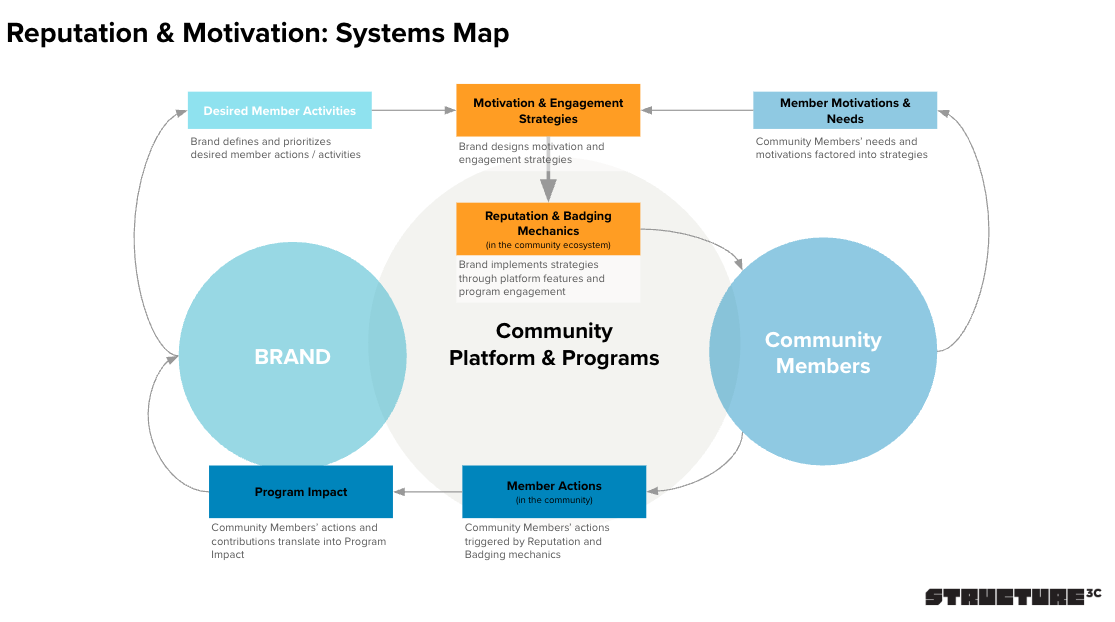
The systems map
Reputation mechanics are the last link in a chain, not the first.
The full sequence:
Desired member activities. The brand defines and prioritizes which member actions actually matter to the business.
Member motivations and needs. What members are independently trying to accomplish, factored in as an input rather than assumed.
Motivation and engagement strategies. The brand designs strategies that serve both at once. This is where the five strategies above live.
Reputation and badging mechanics. The strategies get implemented through platform features and program design. Points, badges, levels, leaderboards.
Member actions. What members actually do, triggered by the mechanics.
Program impact. Those actions and contributions translate into business outcomes, which feed back to the brand.
Most organizations start at step four, because that's what the platform ships with. Starting there means the mechanics reward whatever was easy to instrument rather than what anyone decided was valuable.
The value exchange
Members arrive with a purpose, immediate needs, and long-term goals. The host organization wants business outcomes. The community platform and its programs are the overlap.
The fertile ground for design is the overlap itself. By working from member motivations, providing real engagement support, and offering recognition that carries career weight, the host organization gets members pursuing their own goals in ways that also increase the community's capacity to create value. That capacity compounds: members who advance become the people who support and create for everyone who arrives next.
The leaderboard gap
A leaderboard recognizes ten people. The eleventh member does the math and stops trying. Participation concentrates at the top while everyone else watches, and the gap widens because nobody new can close it.
Programs that avoid this vary recognition along three axes:
Stage of membership. A first accepted answer and a thousandth both get marked. Atlassian's Rising Star triggers at five accepted answers, which is reachable in a first week.
Time horizon. Atlassian runs leaderboards for the last thirty days, the quarter, and all time. The thirty-day board is winnable by someone who joined last month.
Type of action. Mendix recognizes leaders across different sets of actions rather than one. Its four MVP paths mean expertise in support counts as much as expertise in product.
Any one of these alone still leaves most members outside the system. Together they mean a member can find a version of recognition they can plausibly reach today.
Get the full briefing
The full briefing covers all five strategies with annotated examples, the complete systems map, and a mechanic-by-mechanic walkthrough of Salesforce, Atlassian, and Mendix.
Published August 2026. If you're rebuilding a reputation system or standing one up for the first time, get in touch.
Please note: By downloading the report, you agree to cite with attribution. Resale, republication, and commercial reuse require permission. © 2026 Structure3C.
Next steps: We brief teams on this material, review systems that are already running, and design new ones. If you have questions or want to talk through your own, get in touch.
FAQ
What is a community reputation system?
A community reputation system is the set of visible signals (points, badges, levels, leaderboards, roles) that help members judge the quality of content and the expertise of other members, while motivating participation. The mechanics are the visible layer; the strategy determining what gets recognized sits underneath.
Why do most community reputation systems fail?
They start with the mechanics. Platforms ship with points and leaderboards by default, and organizations leave the defaults in place, so the system rewards whatever was easy to measure rather than what the business or the members actually value.
What is the difference between reputation mechanics and motivation strategy?
Mechanics are the tactical tools: badges, points, levels. Motivation and engagement strategy is the upstream work of deciding which member actions matter, understanding what members are trying to accomplish, and designing for the overlap. Mechanics without strategy produce a scoreboard nobody cares about.
How do you stop a leaderboard from discouraging new members?
Recognize at multiple stages of membership, on multiple time horizons, and across multiple types of contribution. A member who cannot realistically reach the all-time top ten should still have a board, a badge, or a path that is reachable this month.