

Co-Creating Tomorrow: The Power of Community in Enterprise Innovation
The Innovation Advantage Competitors Can't Copy
Key characteristics of community-based innovation ecosystems, a portfolio of six modes orchestrated as one system, and profiles of eleven programs from P&G to LEGO.
Every business has to innovate, and none can do it alone. The richest source of insight, validation, and signals from the future is the extended ecosystem already around you: customers, partners, startups, and employees. I've launched dozens of community-based innovation programs, including the pioneering Dell IdeaStorm, and since 2015 Structure3C has studied more than 200 corporate innovation efforts to find what actually works.
The programs that work treat innovation as one connected system rather than a scattered set of idea boards, labs, and venture funds. Ideas surface in community channels, get validated in labs and betas, and mature into ventures and partnerships, each mode feeding the next. The job that holds it together is orchestration: a function whose work is connecting the portfolio and building community among the people in it.
Access to ideas was never the hard part, and it counts for less now that anyone can run a contest. What compounds is relational: developmental relationships and status ladders where participants earn recognition that travels with them across jobs, so the value follows the person and accrues to the brand over years. The eleven programs profiled here, from P&G's Connect & Develop to LEGO Ideas to AWS's Builder-to-Hero ladder, show how this type of community-based advantage gets built and how it is sustained.
The eight characteristics:
Orchestrated program portfolios
Tiered participation with multiple on-ramps
Open innovation across organizational boundaries
A standing channel for community co-creation
Dedicated labs and experience centers
Deep startup and venture engagement
Challenge-driven and mission-aligned
Developmental relationships
1. Orchestrated program portfolios
Programs coordinated across the full innovation funnel by someone whose actual job is to orchestrate them, and who builds community among the internal program owners as well as the external participants. The orchestration role is the part companies skip, which is why most portfolios are a list rather than a system.
AWS runs its startup and builder programs through dedicated internal teams: the AWS Startups org, and the developer-community group behind Heroes and Community Builders. BMW pulls labs, crowdsourcing, its incubator, and its venture arm under one named BMW Group Innovation Network, with the Startup Garage owned inside R&D.
2. Tiered participation with multiple on-ramps
Distinct entry points let different stakeholders engage at the level that fits them. The important part is that on-ramps are a developmental path, not a segmentation scheme. Participants move from crowd to community to collaboration over time, and the program is designed to move them.
The World Economic Forum runs separate tracks for groups like Technology Pioneers and Global Innovators. Siemens layers on-ramps: an open Xcelerator Community for partners and developers, plus dedicated startup and early-career programs.
3. Open innovation across organizational boundaries
The best ecosystems deliberately source ideas and intellectual property from outside the walls, as policy rather than as an occasional experiment.
P&G Connect and Develop draws breakthroughs from external inventors worldwide, built on the principle that a large share of P&G's innovation should originate outside the company. Siemens Xcelerator Community brings customers, partners, and developers together across company lines to co-create solutions and shape product direction.
4. A standing channel for community co-creation
A permanent, always-open channel for the community to shape what gets built. These run on a spectrum: async idea boards at one end, pre-release testing in the middle, and at the high-value end, small facilitated cohorts working live on a bounded problem.
LEGO Ideas and Salesforce IdeaExchange capture ideas continuously. Tableau Pre-Release and Alteryx Pilot let users validate features before launch. Salesforce Impact Labs run facilitated cohorts that co-design solutions to a defined problem across a structured program. The third form is rarest and produces the most.
5. Dedicated labs and experience centers
Physical and virtual spaces give experimentation a home and a front door. They are also where the facilitated, collaboration-tier work in characteristic four actually happens. Without a room, that tier tends not to exist.
Deutsche Telekom pairs T-Labs with the hub:raum incubator's prototyping campus, giving R&D and startups a shared home. AWS Public Sector Innovation Centers and Salesforce Impact Labs prototype directly with customers.
6. Deep startup and venture engagement
Acceleration, incubation, and corporate venture capital wire the brand into external pipelines it could not build internally at any speed.
BMW engages startups through an incubator, the Startup Garage, and BMW i Ventures. P&G Ventures and AWS's Alexa and Industrial Innovation Funds fund external companies directly.
7. Challenge-driven and mission-aligned
Time-bound challenges and a clear purpose concentrate collective energy in a way that open-ended invitations do not. A challenge has a deadline, a scope, and a result, which is why people finish them.
Alteryx Weekly Challenges and AWS Cloud Innovation challenges create recurring, goal-focused engagement. Tableau Public's Iron Viz competition makes skill-building public and competitive, which turns practice into content.
8. Developmental relationships
This is the flywheel. Every participant gets tangible value back, so contribution sustains itself. The strongest programs build long-term, sometimes career-long relationships, identities, and status ladders. The value compounds specifically because those identities are portable: they follow the person across job changes.
LEGO pays a royalty for adopted designs, but the real draw is the AFOL identity and recognized Ambassador status, a community role that outlasts any employer. AWS runs a visible ladder from Community Builder up to invitation-only Hero, and it recognizes the individual rather than the company they work for, so the status travels with them. Tableau Ambassadors and Visionaries, Adobe Community Experts, and the Alteryx ACE council work the same way.
That portability is the point. A program that recognizes accounts builds a customer list. A program that recognizes people builds advocates who seed the product at every employer they ever have.
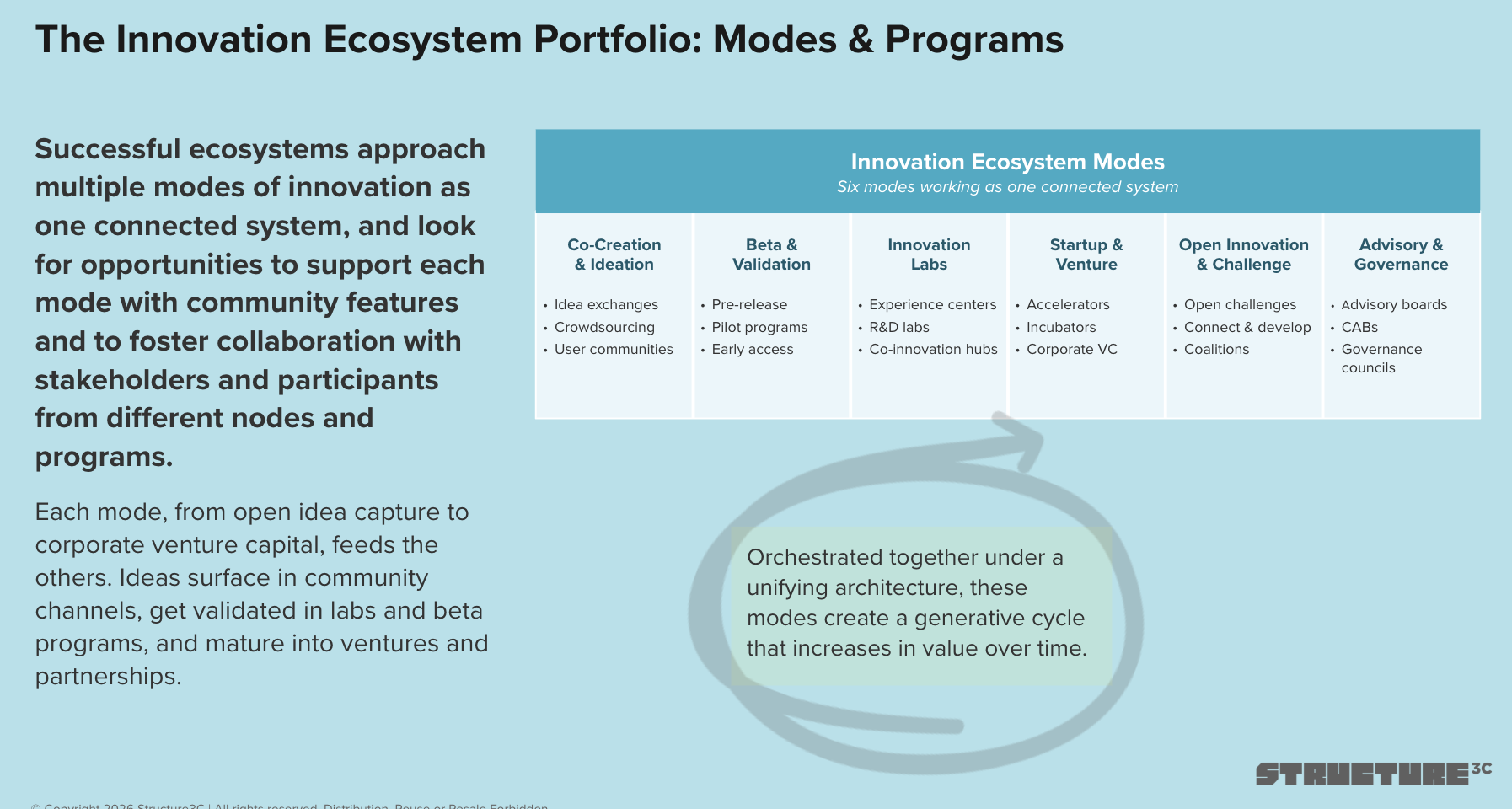
The Innovation Ecosystem Portfolio: Six Modes
Successful ecosystems treat multiple modes of innovation as one connected system, support each mode with community features, and push for collaboration between participants in different modes.
Co-creation and ideation. Idea exchanges, crowdsourcing, user communities. Beta and validation. Pre-release programs, pilots, early access. Innovation labs. Experience centers, R&D labs, co-innovation hubs. Startup and venture. Accelerators, incubators, corporate VC. Open innovation and challenge. Open challenges, connect-and-develop models, coalitions. Advisory and governance. Advisory boards, customer advisory boards, governance councils.
Each mode feeds the others. Ideas surface in community channels, get validated in labs and beta programs, and mature into ventures and partnerships. Orchestrated under one architecture, the modes create a generative cycle that gains value over time. Run as six separate budgets, they produce six separate reports.
The orchestrating function
The ecosystem spans internal groups (executive leadership, innovation and R&D, business units, go-to-market, operations, corporate development and venture) and external ones (customers, partners and suppliers, startups, investors, research and universities, markets and regulators, and the community itself).
What connects them is an orchestrating function: a Community Innovation Center that holds strategy, funding, leadership, and decision rights across the portfolio. Most companies have every component of an innovation ecosystem and no one whose job is to connect them. That gap is the most common and most expensive finding in this research.
Get the full briefing
The full briefing profiles all eleven ecosystems with benefits and business impact for each, and includes both the six-mode portfolio model and the full ecosystem map.
Published August 2026. If you want to talk through your own portfolio, get in touch.
Download the report here.
Please note: By downloading the report, you agree to cite with attribution. Resale, republication, and commercial reuse require permission. © 2026 Structure3C.
Next steps: We brief teams on this material, review systems that are already running, and design new ones. If you have questions or want to talk through your own, get in touch.