
The Community AI Framework
A working map for community leaders and the executives they work with.
Community and AI are now interdependent. When someone asks an AI assistant a question about your product or your industry, the AI is reaching into community conversations to answer. Often yours. Most teams are not yet operating for this.
The Community AI Framework is the map for the work that follows. Built around a clear thesis: community is becoming an ingredient that shows up everywhere your customer experience is delivered, not a destination members go to. The companion worksheet takes you from scanning the framework to picking the one bet worth making in the next 90 days.
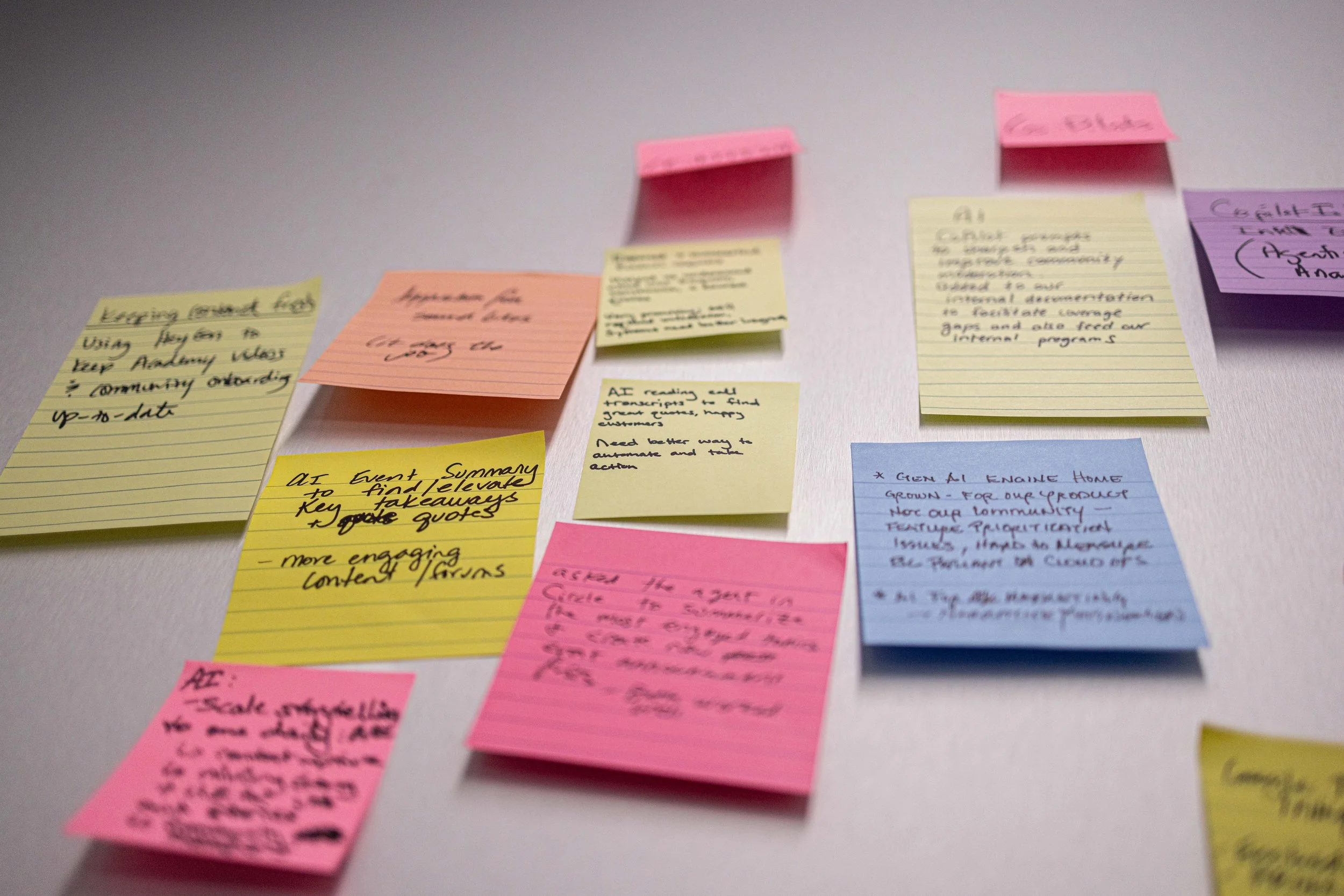
I built the framework in late 2025 and refined it with thirty senior community practitioners at the Structure.Community Winter Summit in February 2026. This is V4, and it is a living document. V5 ships later this year.
The Thesis
Community is becoming an ingredient; the destination and ecosystem still matter.
For twenty years the job was to build a place and get people to come to it. The metrics followed from that: visits, engagement, time on site. Those metrics are now softening in exactly the places where AI works well, and that is not a failure signal. It is a reframing signal.
When someone asks an AI assistant a question about your product or your industry, the assistant reaches into community conversations to answer. Often yours. The value is showing up somewhere you are not measuring, produced by content you did not know was being read, consumed by systems you have no relationship with. Meanwhile the things community has always been good at, real expertise and real trust between real people, are worth more than they were a year ago, precisely because everything else has become abundant and cheap.
The work is to update the value proposition, the measurement model, and the way community teams operate, to match.
What that implies
You need a working grasp of AI that goes past what your platform vendor is shipping. The interesting work is in how agents connect to systems, not in whether the forum has an AI search bar.
You need to measure things you currently do not measure. Impressions, citations, AI-referred conversion, the rate at which other teams use your material in their workflows. The old metrics are not wrong. They are no longer enough.
You need to take member value seriously as something you can describe and defend. Most teams cannot. Teams that can will have an easier time keeping their members and a much easier time keeping their budget.
You need to build. Many of the most useful things in this framework have no turnkey product behind them. Community teams are going to become builders, or partner closely with people who are.
What this is, and what it isn't
This is a map of a domain that has not finished forming. It is not a buying guide, a maturity model, or a vendor comparison. It is the working point of view I and a group of senior community practitioners arrived at over a long day at the Structure.Community Winter Summit in February 2026, updated for what has shifted since.
If you lead a community, or you lead something that depends on one, it is for you.
The Seven Domains
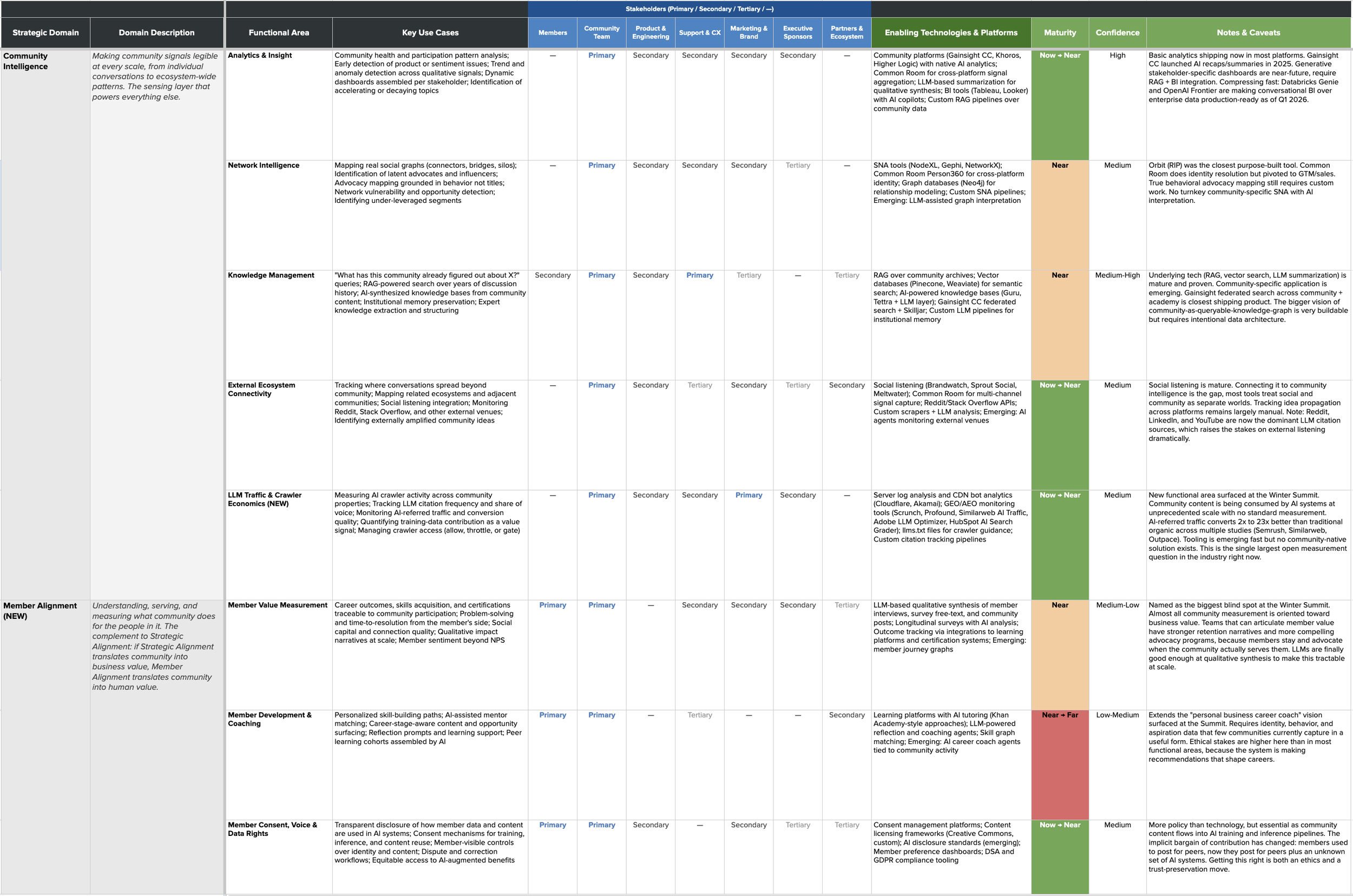
The framework covers seven strategic domains and 21 functional areas. Each domain carries a question for leadership, which is usually the faster way in than the taxonomy.
1. Community Intelligence
The sensing layer that powers everything else. Making community signals legible at every scale, from an individual conversation to an ecosystem-wide pattern.
Leadership question: are we measuring what AI is doing with our community content?
Five functional areas: Analytics and Insight, Network Intelligence, Knowledge Management, External Ecosystem Connectivity, and LLM Traffic and Crawler Economics.
That last one is new in V4 and it is the single largest open measurement question in the industry right now. Community content is being consumed by AI systems at unprecedented scale with no standard measurement. Server logs and CDN bot analytics exist, GEO and AEO monitoring tools are arriving fast, and no community-native solution exists at all. Maturity: now to near.
2. Member Alignment
New in V4, and named at the Winter Summit as the biggest blind spot in the field. Understanding, serving, and measuring what community does for the people in it.
Leadership question: can we articulate what the community does for members, not just for the business?
Three functional areas: Member Value Measurement, Member Development and Coaching, and Member Consent, Voice, and Data Rights.
This is the complement to Strategic Alignment. If Strategic Alignment translates community into business value, Member Alignment translates it into human value. Almost all community measurement points the first direction. The reason to fix that is not sentiment: members stay and advocate when the community actually serves them, so teams that can describe member value have stronger retention narratives. LLMs have only recently become good enough at qualitative synthesis to make this tractable at scale. Maturity: near, confidence medium-low.
The consent piece deserves its own note. The implicit bargain of contribution has changed. Members used to post for peers. Now they post for peers plus an unknown set of AI systems. Getting the disclosure and consent right is an ethics question and a trust-preservation question at the same time.
3. Member Experience
The full arc of how members encounter, navigate, and are guided to act within the community.
Leadership question: is our member experience personalized, or just segmented?
Three functional areas: Discovery and Matching, Adaptive Experience, and Member Action Guidance.
AI search is shipping across major platforms now. Role-based experiences exist but are rule-driven rather than AI-driven, and true generative interfaces remain experimental. This is a build, not a buy. Maturity: now to near for discovery, near to far for adaptive experience.
4. Team Augmentation
Everything that makes community practitioners more effective: working faster, knowing what is next, building what does not exist yet, and doing all of it responsibly.
Leadership question: is our team operating AI, or just using it?
Five functional areas: Operational Augmentation, Team Action Guidance, Build and Experimentation, Content Discoverability and AI Readiness, and Trust, Safety, and Governance.
The most mature domain in the framework, and the one that shifted most in 2026. Single-agent copilots are everywhere. The move now is to multi-agent systems, with community teams orchestrating specialized agents rather than talking to one generalist. Governance and handoff design become the new skill.
Team Action Guidance remains the biggest market gap in the entire framework. No platform ships "here is what needs your attention and why," powered by AI. It is very buildable now that MCP connects the data sources, and substantially more tractable than it was six months ago.
5. Strategic Alignment
The translation layer between community work and organizational value.
Leadership question: are we using the same attribution language as our peers in marketing and sales?
Two functional areas: Strategic Operations, and ROI and Value Translation.
The biggest shift after the Summit lives here. The value proposition is moving from community-as-destination, measured in visits and engagement, to community-as-ingredient, measured in impressions, surface area, AI citations, and consumption by other teams' AI systems. Traditional engagement metrics may decline where AI search works well. Good search means less engagement, and that is a reason to reframe the measurement model rather than evidence of failure.
The practical move: adopt the attribution models other departments already use, associated, influenced, and sourced, and hedge toward underestimation. Maturity: now to near.
6. Innovation and Foresight
Past ideation, toward shared sensemaking and futures work.
Leadership question: where is community feeding long-horizon strategy, not just next-quarter metrics?
One functional area of the same name, covering community-based futures workshops, high-trust collaboration spaces, trend synthesis, and scenario development.
Ideation platforms exist but are not community-native. What this requires is community signals plus LLM synthesis plus actual foresight methodology, which almost nobody is combining. One signal worth tracking: agentic commerce is projected at three to five trillion dollars by 2030, and community recommendations feeding agent-mediated purchase flows is a near-future use case nobody has designed for yet. Maturity: near to far.
7. Enterprise Integration
The connective tissue that makes community data actionable where decisions actually get made, and consumable by other teams' AI systems.
Leadership question: is our community data consumable by other teams' AI systems?
Two functional areas: Enterprise Integration and MCP, and Cross-Functional AI Orchestration.
MCP moved from emerging standard to default integration substrate inside six weeks. The open question is no longer whether MCP is the standard. It is what a community-specific MCP server looks like, and that is currently unanswered.
Cross-Functional AI Orchestration is new in V4 and came directly out of the Summit. The frame: stop pitching community as a destination, position it as an ingredient that mixes into every other program's AI workflows. This is where the most receptive executive conversations are happening right now. It is structurally different from Enterprise Integration because the relationship is not community-to-system, it is community-team-to-other-team. Maturity: now.
The Maturity and Confidence Estimates
Every functional area carries two estimates rather than recommendations:
Maturity places the area on a horizon: now, now to near, near, near to far. It answers whether you could do this today with things that exist.
Confidence is how sure I am about that placement, from high down to low-medium. A low-medium confidence rating is not a warning to stay away. It usually marks the areas where the opportunity is largest and the tooling is thinnest, which is exactly where a team willing to build has an advantage.
How To Use This
Skim the seven domains to get the shape of the territory, then go back and read the Notes and Caveats column carefully. That column is where the argument is. The rest is structure.
When you find a functional area that matters to your program, look across the stakeholder columns. V4 splits stakeholders seven ways: Members, Community Team, Product and Engineering, Support and CX, Marketing and Brand, Executive Sponsors, and Partners and Ecosystem. If the people marked Primary for that area are not currently in your working conversations, that gap is the first thing to fix.
Frameworks do not change anything. Conversations do.
The Opportunity Canvas
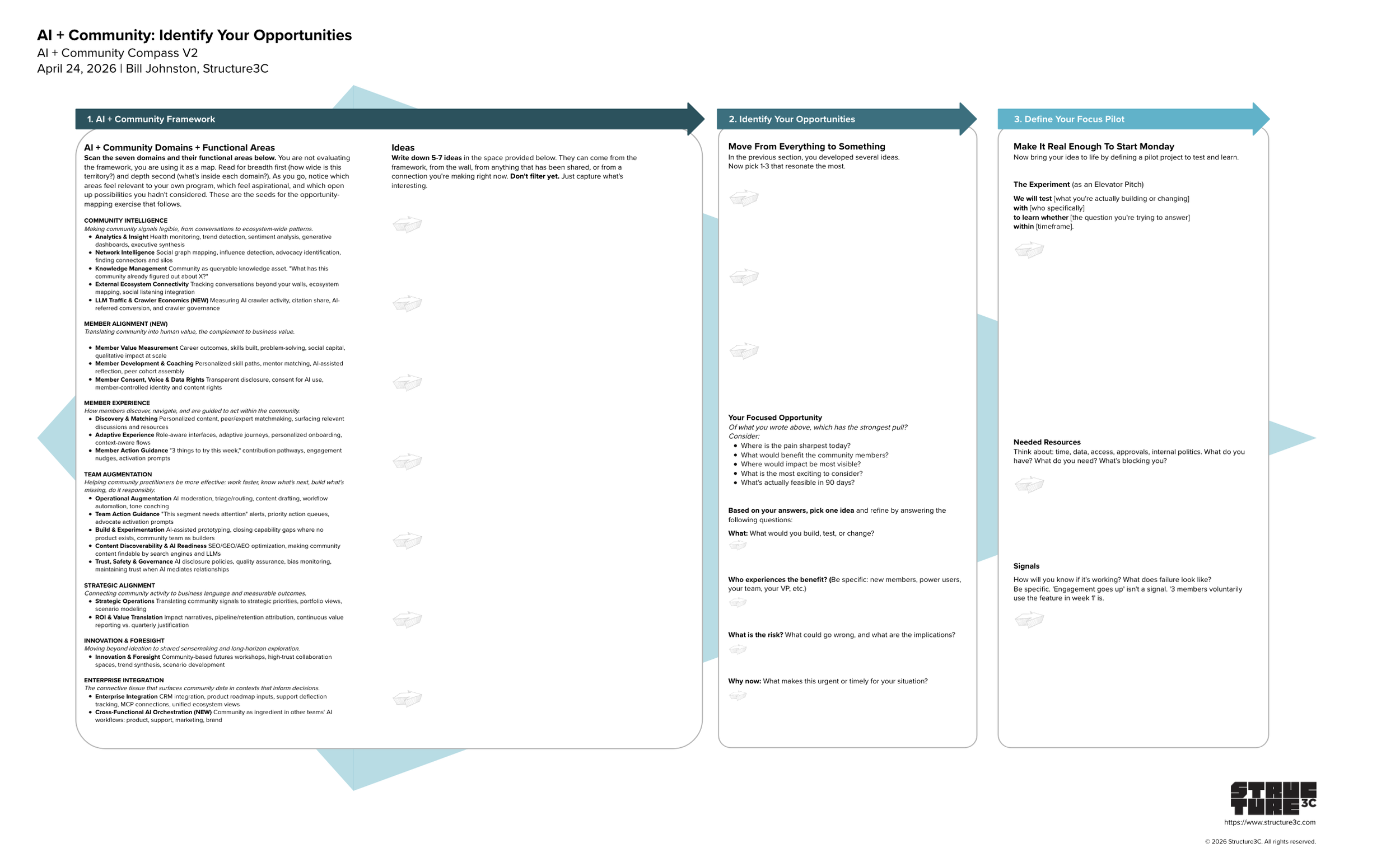
The companion worksheet takes you from scanning the map to picking one thing worth piloting in the next 90 days. Three steps, one sitting:
Scan the map. Read the seven domains and their functional areas. You aren't evaluating the framework, you're using it as a map: breadth first, how wide is this territory, then depth, what's inside each domain. As you go, notice which areas are relevant to your program today, which feel aspirational, and which open up something you hadn't considered. Capture five to seven ideas without filtering.
Move from everything to something. Pick one to three that pull hardest. Where is the pain sharpest today? What would benefit members? Where would impact be most visible? What is actually feasible in 90 days? Then pick one and answer four questions about it: what would you build, test, or change; who specifically experiences the benefit; what is the risk; and why now.
Define the pilot. Make it real enough to start Monday. State the experiment as a sentence: we will test [what] with [who] to learn whether [question] within [timeframe]. Then name the resources you need and the signals you will watch. Be specific about the signals. "Engagement goes up" is not a signal. "Three members voluntarily use the feature in week one" is.
Version History:
Originally drafted in late 2025 and then refined over a full day with thirty senior community practitioners at the Structure.Community Winter Summit in San Francisco, February 2026. Updated in April for what has shifted: three functional areas and one entire domain are new in V4, and two areas were upgraded a full maturity step in six weeks.
This is V4. V5 ships later in 2026, sharpened by what people find when they use this one.
If you adapt it, build on it, or push back on it, I want to hear from you. bill.johnston@structure3c.com
If you only do one thing
Pick one functional area you are not currently working on. Find one Primary stakeholder you are not currently talking to. Have a thirty-minute conversation about whether it belongs on your roadmap.
That is where the value is.
The Community AI Framework (V4)
link
Please note: By downloading the report, you agree to cite with attribution. Resale, republication, and commercial reuse require permission. © 2026 Structure3C.
The Community Opportunity Canvas (V2)
FAQ
What is the Community AI Framework?
The Community AI Framework is a working map of the seven strategic domains where community and AI intersect: Community Intelligence, Member Alignment, Member Experience, Team Augmentation, Strategic Alignment, Innovation and Foresight, and Enterprise Integration. It covers 21 functional areas with use cases, stakeholder maps, enabling technologies, and a maturity and confidence call for each.
What does "community as an ingredient" mean?
It means community value increasingly shows up outside the community itself: in AI-generated answers that cite community conversations, in other teams' AI workflows that consume community data, and in support, product, and marketing systems that draw on community knowledge. The measurement model has to follow, from visits and engagement toward impressions, citations, and cross-team consumption.
How should community teams measure AI-driven value?
Track AI crawler activity across community properties, LLM citation frequency, AI-referred traffic and its conversion quality, and the rate at which other teams consume community data in their own AI systems. Then translate those into the attribution models other departments already use, associated, influenced, and sourced, rather than inventing community-specific vocabulary nobody else recognizes.
What is the biggest gap in community AI tooling right now?
Team Action Guidance. No platform ships an AI-powered answer to "what needs your attention and why." Customer success platforms do health scoring at the customer level, not the community level. It is buildable now that MCP connects the underlying data sources, and it remains unbuilt.
Which stakeholders should be involved?
It depends on the functional area, which is why the framework maps seven stakeholder groups against each one: Members, Community Team, Product and Engineering, Support and CX, Marketing and Brand, Executive Sponsors, and Partners and Ecosystem. The practical test is whether the people marked Primary for an area you care about are already in your working conversations.